
Events & Webinars
Consensus Miami 2026 Keynote: Why stablecoins need real-world utility to reach everyday users
/ Events & Webinars
Published May 18, 2026
Written by Protocol Theory
◻️ At Consensus Miami 2026, Alistair Rennie challenged the idea that faster and cheaper payments alone will drive stablecoin adoption. Watch his keynote on the role of programmable utility, real-world use cases, and demand-side innovation.
At Consensus Miami 2026, Protocol Theory’s Global Head of Innovation & Thought Leadership, Alistair Rennie, took the stage to challenge one of the most common assumptions in stablecoin adoption.
The standard argument is familiar: stablecoins are faster and cheaper, so consumers will eventually adopt them.
Alistair’s keynote made a more demanding case.
Speed and cost matter. But they are unlikely to be enough. If stablecoins are going to become part of everyday financial life, the industry needs to focus less on infrastructure benefits and more on practical utility: what programmable money can actually do for people, businesses, wallets, agents, and payment experiences.
That is the central idea behind Alistair’s presentation, The iPhone Moment for Money: Programmable and Agentic Stablecoin Innovation.
Watch the full keynote
Alistair’s keynote draws on Protocol Theory’s latest programmable money research, based on a survey of 3,020 adults across Australia, the United States, and the United Kingdom.
Download the one-page summary to see the top programmable money use cases most likely to drive provider switching, including anti-fraud programming, programmable parent money, smart travel insurance, programmable loyalty rewards, verified delivery, subscription management, and credit building.
Download the one-page research summary: Top 10 Programmable Money Use Cases
Faster and cheaper will not be enough
Much of the stablecoin conversation still focuses on infrastructure: faster settlement, lower fees, 24/7 liquidity, better cross-border payments, and improved rails.
These benefits are important. For businesses, platforms, and financial institutions, they can be significant.
But consumer behaviour rarely changes on efficiency alone.
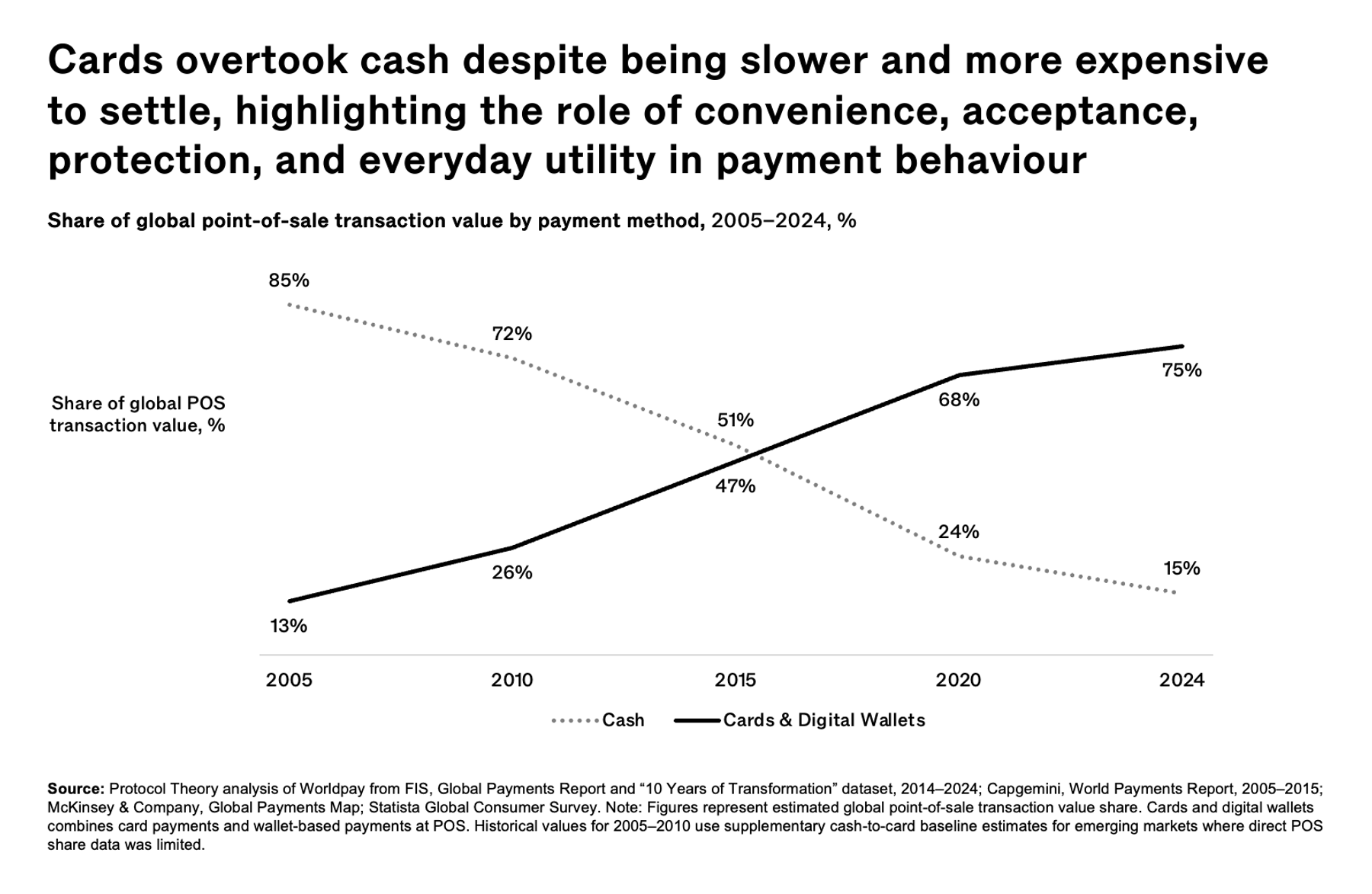
In the keynote, Alistair used card payments as a simple but powerful example. Compared with cash, card payments can involve higher fees and slower settlement. Yet cash has continued to decline while cards and digital wallets have become increasingly dominant.
Between 2005 and 2024, cash’s share of global point-of-sale transaction value fell from an estimated 85% to 15%. Over the same period, cards and digital wallets rose from 13% to 75%.
The implication is important for stablecoin builders.
People do not choose payment methods only because they are technically faster or cheaper. They choose what feels convenient, trusted, familiar, protected, accepted, rewarding, and useful in everyday life.
This is the challenge for stablecoins.
If the category wants to move beyond infrastructure and into mainstream behaviour, the industry needs to give people stronger reasons to care.
The next stablecoin battle is happening at the demand layer
Alistair’s keynote argued that stablecoin innovation is entering a new phase.
The industry has spent years improving the “pipes”: issuance, reserves, settlement, liquidity, interoperability, compliance, and infrastructure.
The next phase will depend on the “taps”: the wallets, apps, agents, services, merchant tools, embedded experiences, and trusted interfaces through which people actually encounter programmable money.
This is where demand is created.
The history of technology adoption shows that infrastructure becomes transformative when it becomes usable, habitual, and valuable through the demand layer. The internet created the conditions for digital services. Smartphones made many of those services part of daily life.
Stablecoins may be approaching a similar moment.
The question is whether the industry can move from better rails to better experiences.
What consumers want from programmable money
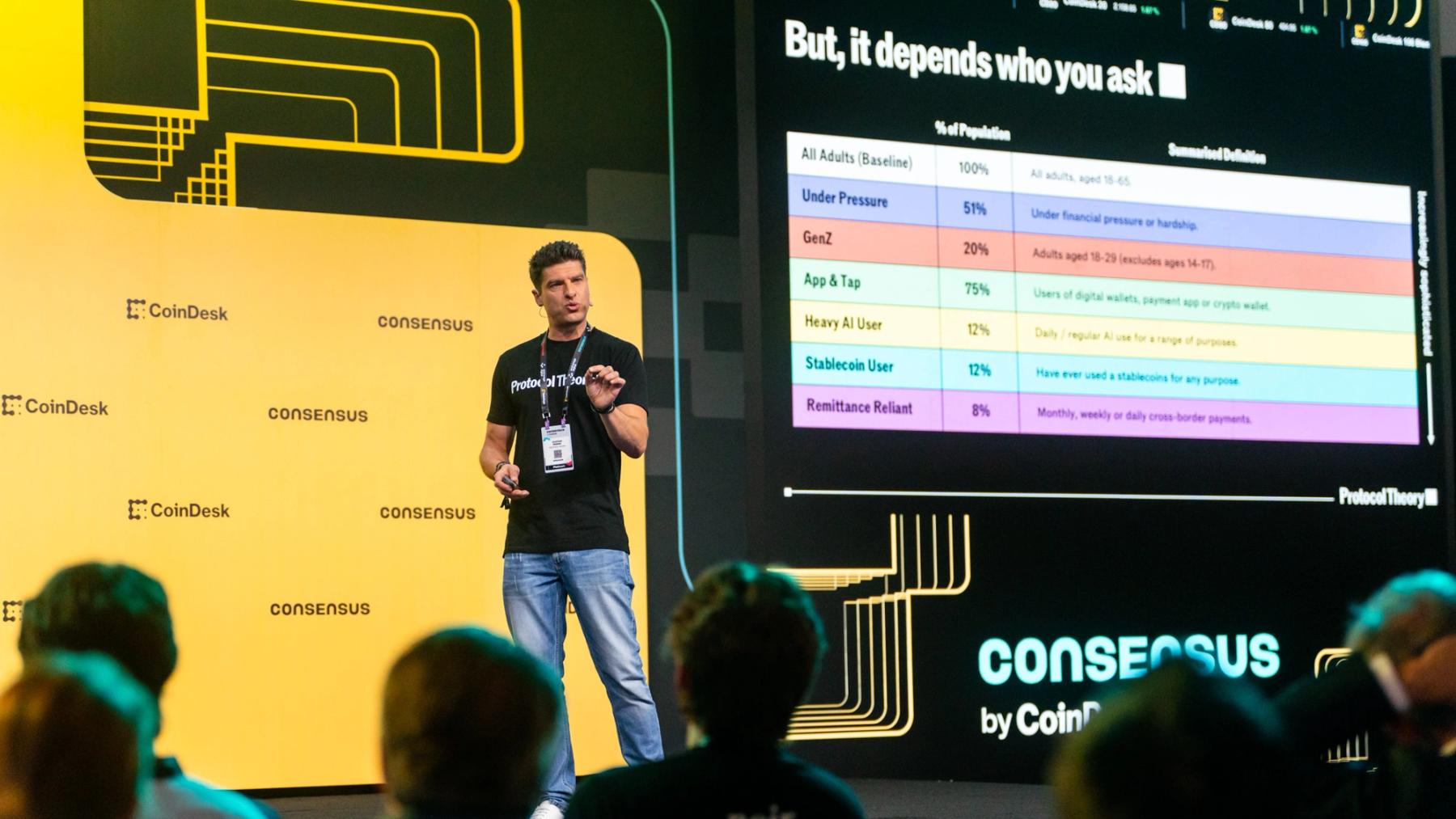
Drawing on Protocol Theory’s April 2026 consumer research across Australia, the United Kingdom, and the United States, Alistair showed where demand for programmable money is beginning to form.
The strongest use cases are not just about moving money faster. They are about helping people protect, optimise, and control their money.
Anti-fraud programming ranked first overall, with 50% of adults saying they would be very or extremely likely to switch to a trusted provider offering it. Among heavy AI users, this rose to 70%.
Other high-performing use cases included programmable parent money, smart travel insurance, programmable loyalty rewards, verified delivery, subscription management, credit building, live income streaming, and live utility payments.
The pattern is revealing.
The strongest consumer opportunities are those that solve familiar problems in more intelligent ways. Money that can follow rules. Money that can respond to conditions. Money that can protect users from fraud. Money that can release funds when delivery is verified. Money that can help parents manage spending. Money that can safeguard AI agent transactions.
This is where programmable money becomes practical utility.
Stablecoins need real-world use cases
For stablecoin platforms, wallets, fintechs, payment providers, and agentic commerce builders, the implication is clear.
The consumer adoption challenge is not simply to explain why stablecoins are faster and cheaper. It is to show what stablecoins can make possible.
That may include:
- payments that protect consumers from fraud
- wallets that automatically manage subscriptions
- escrow-style payments that release when delivery is verified
- parent-controlled spending rules for children
- financial tools that support credit building
- live income streaming for workers
- automated utility payments based on usage
- safeguards that prevent AI agents from making costly spending mistakes
These are tangible, everyday use cases.
They make programmable money easier to understand because they connect the technology to problems people already recognise.
From infrastructure advantage to consumer value
The keynote’s broader message is that stablecoin adoption will be shaped by the companies that understand demand, not just infrastructure.
Lower fees and faster settlement may help explain why stablecoins matter to institutions. Practical utility will help explain why they matter to consumers.
The next generation of stablecoin winners may be the companies that make programmable money feel useful before it feels technical.
That means building products that help people reduce risk, manage complexity, improve control, and make better financial decisions.
Or, as Alistair put it in the keynote:
“Historically, at least, it is not fees and settlement time that has been driving behaviour. Cheaper and faster is now just table stakes. For stablecoins, we have to give people a reason to use them.”
Download the programmable money one-pager
Want the key data behind the keynote?
Download Protocol Theory’s one-page summary of the research, including the top 10 programmable money use cases ranked by switching propensity and three implications for payment providers, wallets, fintechs, and stablecoin platforms.
Download the one-page research summary: Top 10 Programmable Money Use Cases
Sign up to receive exclusive Protocol Theory research on programmable money, agentic stablecoins, and the demand-side future of consumer finance.
Related articles
Events & Webinars
Industry Insights