
Events & Webinars

Self-Custody Has a Relevance Problem
/ Thought Leadership
Published May 1, 2026
Written by Jonathan Inglis
◻️ Crypto users believe in self-custody, yet most still rely on centralized platforms. Drawing on Protocol Theory’s latest research with Tangem, this piece explores why the real barrier may be perceived relevance, and what operators can do about it.
The biggest barrier to self-custody adoption is perceived relevance
Crypto users believe in self-custody. That much is clear.
In our latest research with Tangem, two-thirds of U.S. crypto users said self-custody is important. Among cold wallet users, that figure rises to 83%. Many users also agree that self-custody gives them full control over their assets, sits at the core of what makes crypto valuable, and is preferable to relying on centralized platforms.
At the same time, user behavior tells a more complicated story. Centralized exchanges remain the dominant environment for holding and managing crypto. In our research, 88% of U.S. crypto users said they use centralized exchanges for holding and managing assets, compared with just 15% who use cold wallets.
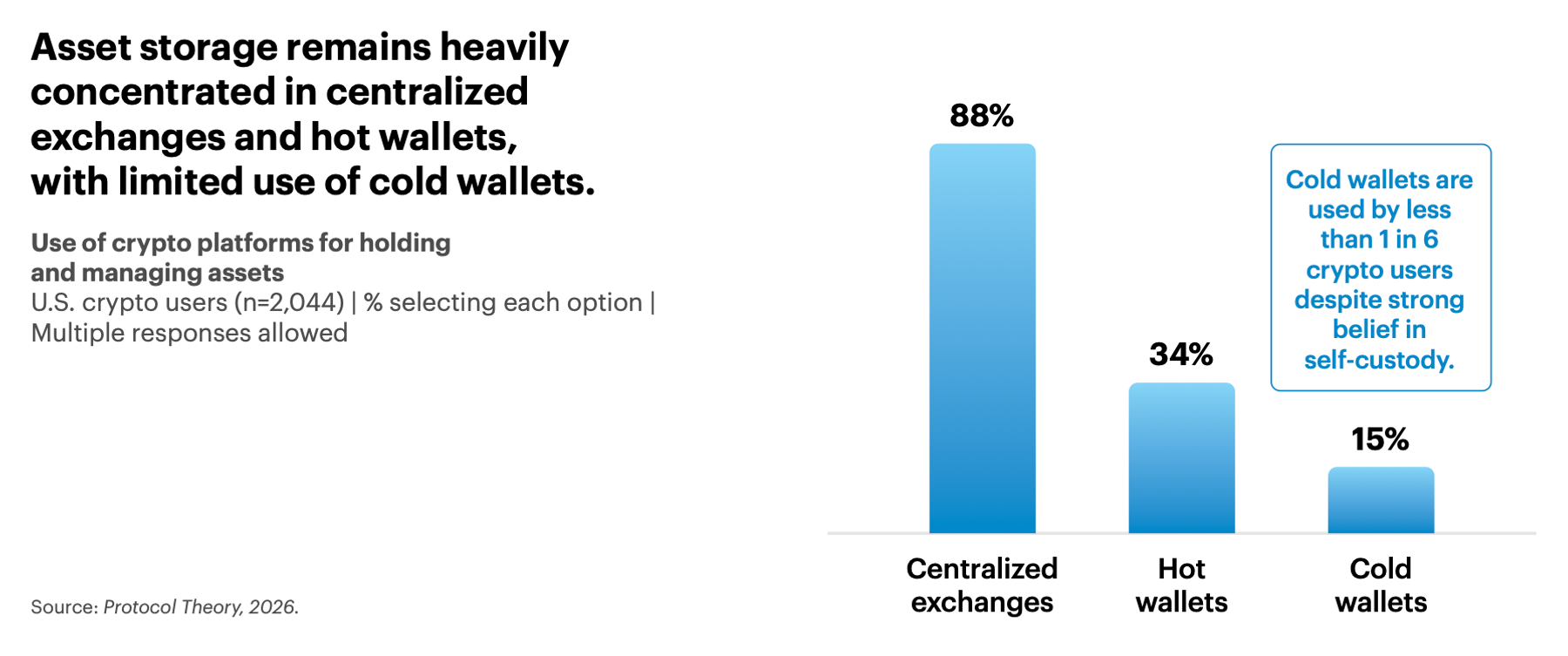
That creates one of the more important adoption gaps in the category. Users broadly believe in self-custody. They understand its philosophical importance. They recognize the risks of centralized platforms. Yet most still manage their assets through intermediated environments.
The usual explanation is that self-custody is too complex, too technical, too expensive, or too risky. Those barriers are real. But they are only part of the story. The deeper issue is that many users still do not see self-custody as relevant to them.
Many users think self-custody is for someone else
When we asked crypto users why they do not use a cold wallet, the leading reason was not cost. It was not usability. It was not even security anxiety. The leading barrier was perceived lack of need.
Among crypto users who had never used a cold wallet, 32% pointed to some form of perceived lack of need, often because they believed cold wallets were only necessary for large holdings, long-term storage, or unusually security-conscious users.
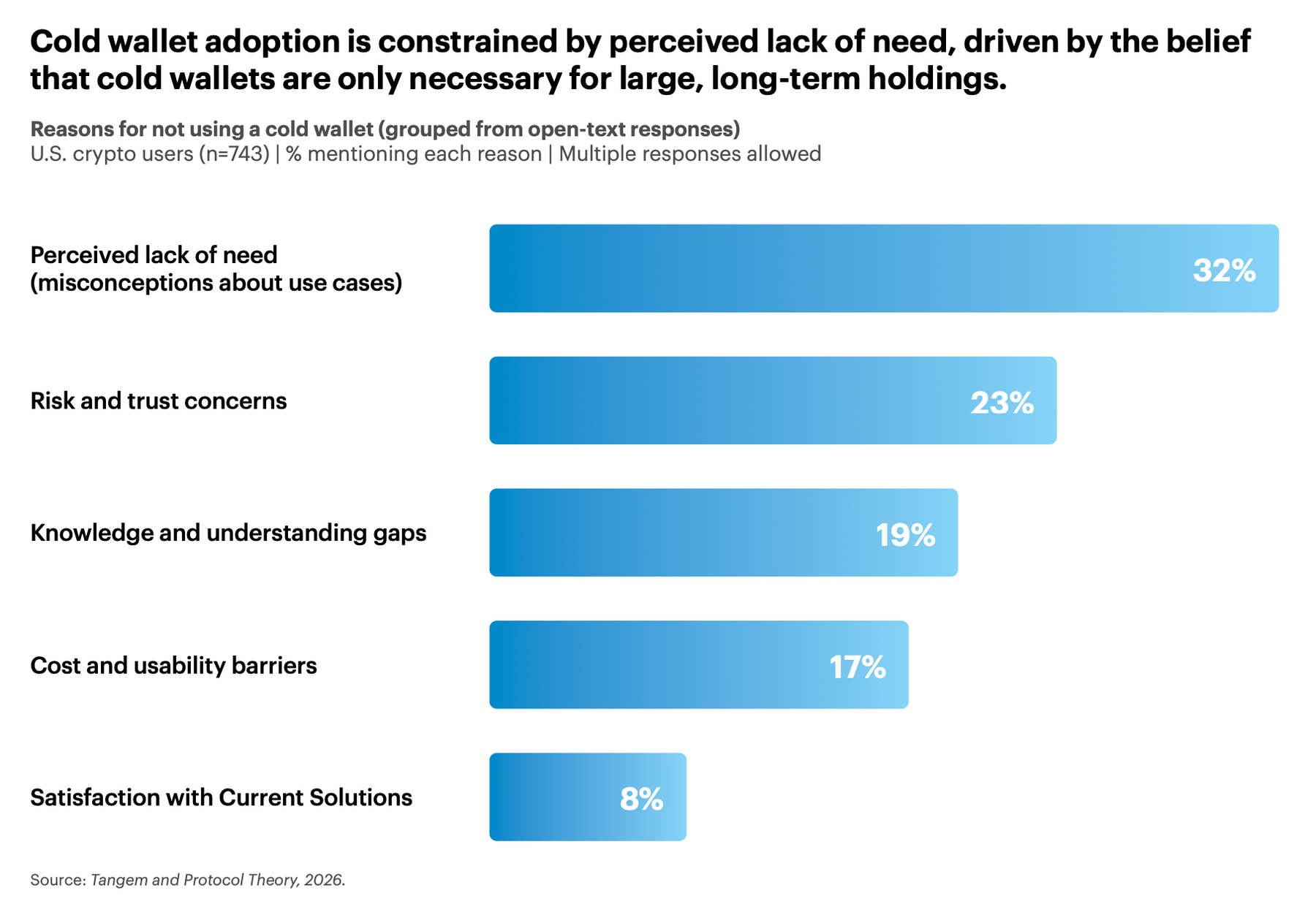
That matters because perceived relevance shapes consideration. If a user thinks cold wallets are only for people with large portfolios, then they will not consider one while their balance is modest. If they think cold wallets are only for long-term storage, then they will not consider one while they are actively trading, transferring, staking, or spending. If they think self-custody is mainly a safety device, then they will not necessarily see it as part of their everyday crypto experience.
In other words, self-custody is often understood as something users graduate into, rather than something that helps them participate more effectively today. That is a strategic problem for the industry, because it means the adoption barrier is not just functional. It is conceptual.
The industry has inherited a narrow mental model
Most crypto users appear to operate with an implicit role-based model of custody. Centralized exchanges are seen as the convenience layer. They provide ease of use, liquidity, simple onboarding, and straightforward on- and off-ramps. Hot wallets are seen as the activity layer. They support transfers, staking, yield generation, and engagement with onchain applications. Cold wallets are seen as the protection layer. They are associated with security, long-term holding, and asset protection.
This model is internally coherent. It also made sense historically. Early self-custody products were often designed and experienced as secure storage tools. They were important, but relatively narrow. Useful for safeguarding assets. Less clearly connected to everyday participation.
But the category has moved on. Modern self-custody wallets increasingly support trading, staking, swaps, asset management, application access, stablecoin usage, and transaction execution. The user experience has improved. Integrations have expanded. Wallets have become more active interfaces for managing and moving value.
Yet the mental model has not fully caught up. That is the gap. The market still talks about self-custody as storage, while many users are already using it as an operating layer.
Active self-custody is already visible in user behavior
One of the most interesting findings in the research is that cold wallet users are more active than many people assume. Only 9% of cold wallet users were passive holders, compared with 25% of centralized exchange users. Cold wallet usage was also more common among active traders than passive owners.
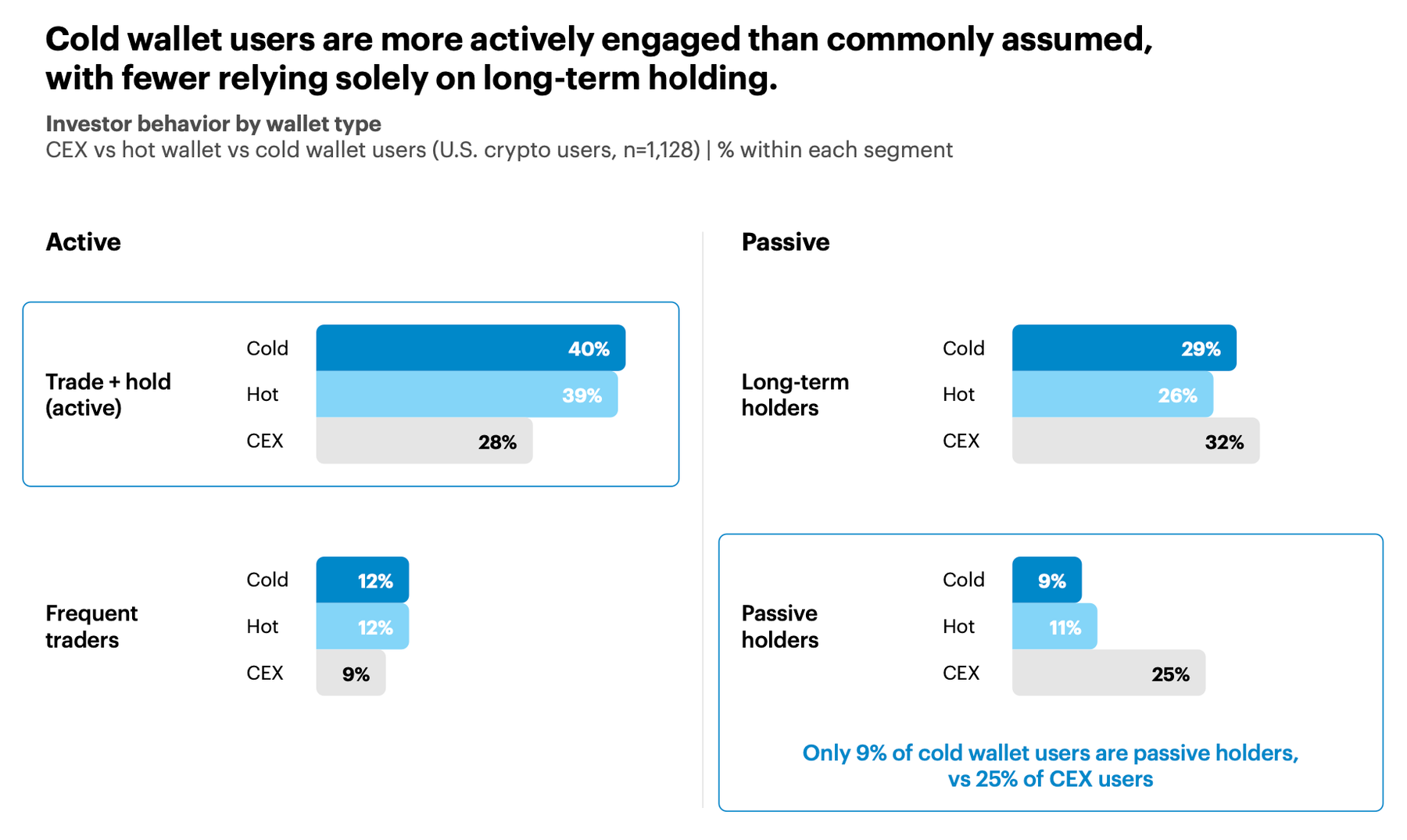
That runs counter to the common assumption that cold wallets are mainly for people who want to lock assets away and rarely touch them. The same pattern appears in use cases. Cold wallet users are not only buying, selling, or holding crypto. They are also storing and using stablecoins, managing multiple wallets or assets across chains, sending crypto to other people or businesses, and connecting to Web3 applications.
This is why we describe the shift as the rise of Active Self-Custody: a mode of participation where users engage across three core functions while maintaining direct control over their assets.
- Storing, to preserve and protect value.
- Growing, to deploy capital through trading, staking, yield, and portfolio activity.
- Spending, to move value across people, businesses, wallets, platforms, and applications.
The important point is that these functions are increasingly converging. For many users, crypto is no longer held in one place and used somewhere else. It is managed through a control point that can support ownership, authorization, and execution in the same environment.
That changes the strategic role of self-custody. It is less useful to think of it only as a storage mechanism. Increasingly, it functions as a control layer.
The operator implication: stop selling self-custody only as protection
For industry operators, this distinction matters. If self-custody is framed mainly around protection, the category will continue to appeal most strongly to users who already feel exposed, already hold meaningful balances, or already understand the risks of centralized custody.
That limits the market. A security-led message can be compelling, but it can also reinforce the idea that self-custody is only needed in specific situations. The bigger opportunity is to expand the perceived use case.
Self-custody brands need to help users understand why direct control matters during everyday participation, not only during long-term storage. That means making the active use cases more visible: managing assets across wallets and chains, using stablecoins, sending and receiving funds, staking or earning yield, accessing applications, authorizing transactions, and moving between platforms without surrendering control.
The message should not only be “protect your assets.” It should also be “participate with control.” That is a broader, more commercially useful frame.
Exchanges also need to pay attention
This is not only a wallet provider issue. Centralized exchanges remain central to the crypto user journey. They provide access, liquidity, education, and convenience. For many users, they are the first trusted interface into the category.
But the research suggests that custody preferences are more nuanced than current behavior implies. Many users value self-custody in principle. Many are concerned about exchange or platform breaches. Yet most still rely on exchanges because they are familiar, convenient, and understood.
That creates both risk and opportunity for exchanges. The risk is that users gradually separate access from control. They may still use exchanges for liquidity and transactions, while increasingly expecting direct ownership and self-custody options to sit alongside the core experience. The opportunity is to help users move across the custody journey more confidently.
This could include clearer education, integrated wallet pathways, self-custody partnerships, guided transfers, low-risk trials, and hybrid experiences that let users start small without feeling they have to abandon convenience. The next phase of custody is unlikely to be a simple exchange-versus-wallet battle. It is more likely to be a question of how users combine access, activity, and control across the ecosystem.
Education is necessary, but experience is stronger
There is also a broader lesson here for product and growth teams. Awareness alone is insufficient. The research shows that cold wallet usage rises sharply with wallet knowledge. Among users with no wallet knowledge, only 4% use cold wallets. Among those with expert knowledge, usage rises to 58%.
But the experience gap is just as important. Users who have direct experience with cold wallets are more likely than CEX-only users to recognize the benefits of self-custody, including privacy, control, safety, flexibility, and access to tools beyond centralized exchanges. They are also more likely to see self-custody as easy to test, possible to try with small amounts, and a natural extension of the tools they already use.
This suggests a practical adoption pathway. Users need enough understanding to see relevance. They need enough exposure to update their perceptions. They need enough confidence to act.
For operators, this means the challenge is not only to explain self-custody more clearly. It is to design low-friction ways for users to experience it safely. Small-balance trials matter. Guided onboarding matters. Plain-language risk explanations matter. Transaction previews, confirmations, recovery education, and confidence-building UX all matter.
Because the final barrier is psychological as much as technical. Self-custody asks users to take more direct responsibility for their assets. That can be empowering, but it can also feel unforgiving. Concerns about losing access, making irreversible transaction errors, or having a wallet compromised remain highly salient.
Good product design should treat that confidence barrier as central to adoption.
The market needs a broader definition of self-custody
The most important implication is simple. Self-custody adoption will not grow only by telling people that centralized platforms are risky. It will grow when users understand self-custody as practically useful.
Useful for storing. Useful for growing. Useful for spending. Useful for managing value across an ecosystem where control, access, and participation are increasingly connected.
That requires a broader category frame. Self-custody is still about ownership. It is still about security. It is still about reducing reliance on intermediaries.
But for the next phase of the market, its relevance will depend on whether users see it as part of how crypto is used, rather than only where crypto is stored.
That is the operator challenge. The industry has spent years teaching users why self-custody matters. The next task is showing them where it fits into their lives.
To explore the full data and implications, read From Storage to Participation: The Rise of Active Self-Custody, a new report from Protocol Theory and Tangem based on research with more than 3,100 U.S. crypto users. ◼️
About the author

Jonathan Inglis
Jonathan Inglis is Founder and CEO of Protocol Theory, a global consumer research and strategic insight company focused on the future of money, technology, and digital markets. He helps leading organisations use evidence, behavioural science, and human insight to sharpen strategy, strengthen market fit, and create influential thought leadership.
Related articles
Events & Webinars
Industry Insights